

DANIEL B REINFELD, PA
Hollywood Personal Injury & Car Accident Attorneys
Serving Clients Throughout South Florida Since 1999
Hollywood Bicycle Accident Lawyer
Over 25 Years of Experience • Former Insurance Defense AttorneyJury Trial-Tested • Millions Recovered for Clients
Daniel B Reinfeld, PA represents people injured in bicycle accidents in Hollywood, Broward County, and throughout South Florida. We investigate how the crash occurred, identify the people and companies legally responsible, determine the insurance coverage available, document the full extent of the cyclist's injuries and damages, and pursue compensation from the responsible parties and their insurers.





Rideshare Accidents
Uber, Lyft, Rideshare & Delivery App drivers, insurance disputes
Wrongful Death
Fatal crashes, family claims, lost support, loss of companionship
When a Hollywood Bicycle Accident Causes Life-Changing Injuries
A bicycle ride can turn into a life-changing event in seconds when a driver fails to see a cyclist, violates the cyclist's right of way, passes too closely, opens a vehicle door into the cyclist's path, or otherwise causes a collision. Unlike occupants of cars and trucks, bicyclists have almost nothing protecting them from the force of an impact. The resulting injuries can be severe, permanent, and extraordinarily expensive.
Why Injured Cyclists Choose Daniel B Reinfeld, PA
Daniel B Reinfeld brings more than 25 years of legal experience, prior insurance-defense knowledge, direct attorney involvement, and a trial-focused approach to serious injury claims.
Direct attorney access: The attorney handling the claim remains directly involved.
Early evidence preservation: Video, electronic data, the bicycle, vehicle damage, and scene evidence are identified promptly.
Insurance-defense insight: Potential insurer defenses are analyzed before they shape the value of the claim.
Coverage analysis: Liability, PIP, UM/UIM, commercial, health-insurance, and other potential coverage are evaluated.
Trial preparation: The claim is prepared for litigation and trial when the insurer does not offer fair compensation.
Demonstrated results: The firm obtained a verified Top-10 Florida pedestrian verdict in 2024.
Bicycle accident cases present issues that do not always arise in an ordinary motor vehicle accident. Florida's bicycle laws can affect right of way and liability. The driver's insurance company may attempt to blame the cyclist. Questions may arise concerning Personal Injury Protection (PIP), uninsured or underinsured motorist coverage, health insurance, damage to an expensive bicycle, and whether additional parties share responsibility for the crash.
Evidence can also disappear quickly. Surveillance footage may be overwritten. Vehicles may be repaired. Road conditions can change. Witnesses become harder to locate. The bicycle, helmet, clothing, GPS data, photographs, video, and electronic cycling records may all become important evidence.
If you were injured while riding a bicycle, understanding who caused the bicycle accident, what insurance applies, and what compensation Florida law allows you to recover can be critical to protecting your claim.
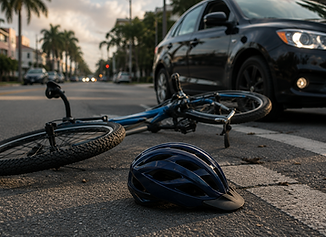


Florida Bicycle Accident Claims Are Different From Car Accident Claims
A serious bicycle accident should not automatically be treated as simply another automobile accident claim. When two passenger vehicles collide, seat belts, airbags, the vehicle frame, and other safety systems can reduce the forces reaching the occupants. A cyclist struck by a motor vehicle has no comparable protection. The initial vehicle impact may be followed by an impact with the pavement, another vehicle, a curb, or another fixed object. As a result, a bicycle collision can produce traumatic brain injuries, fractures, spinal injuries, internal injuries, severe road rash, scarring, orthopedic injuries, and permanent impairment even when the motor vehicle was not traveling at highway speed.
Bicycle cases also raise their own liability and insurance questions. An investigation may require determining:
The analysis may include whether the driver failed to yield to the cyclist, whether the cyclist had the right of way, whether the driver made an unsafe right or left turn, whether the motorist passed the bicycle safely, and whether the cyclist was lawfully using a bicycle lane, roadway, sidewalk, or crosswalk.
Additional considerations may include whether poor roadway design or maintenance contributed to the accident, whether Florida bicycle lighting, equipment, or traffic laws are relevant, whether the driver was distracted, impaired, or speeding, whether the driver was working at the time of the collision, and what automobile, PIP, UM/UIM, commercial, or other insurance coverage may apply. These issues make early investigation particularly important in a serious Florida bicycle accident claim.
What Should You Do After a Bicycle Accident in Florida?
The period immediately following a bicycle crash can affect both your health and your ability to prove what happened.
If your condition allows, important steps after a bicycle accident include:
Call 911 and report the bicycle accident. Ask law enforcement and emergency medical personnel to respond when appropriate. Obtain medical attention. Some serious injuries may not be fully apparent immediately after a crash. Identify the driver and vehicle. Obtain the driver's name, contact information, license information, vehicle information, and insurance information. Photograph and video the accident scene. Document vehicle positions, bicycle damage, skid marks, debris, traffic controls, bicycle lanes, roadway conditions, and visible injuries. Identify witnesses. Obtain contact information from anyone who saw the collision or the events immediately before or after it.
Preserve your bicycle and equipment. Do not immediately repair or dispose of the bicycle, helmet, damaged clothing, lights, cycling computer, or other equipment. Preserve electronic evidence. Garmin, Wahoo, Strava, smartphone, GPS, action-camera, and other electronic information may help establish speed, location, route, timing, or other facts. Look for cameras. Nearby businesses, residences, vehicles, intersections, and security systems may have captured the collision. Be careful when communicating with insurance companies. Statements made shortly after the crash may later be used to dispute liability or damages. Investigate the claim promptly. Valuable evidence can disappear long before the legal deadline for filing a lawsuit.
Who Is Liable for a Bicycle Accident in Florida?
Determining who is at fault for a bicycle accident requires examining what each person involved was doing immediately before the collision and applying Florida negligence and traffic laws to those facts.
In many cases, a negligent driver is responsible. Other bicycle accidents involve multiple responsible parties.
Driver Negligence in a Bicycle Accident
Motorists can cause bicycle accidents by:
Examples include failing to yield, making unsafe right or left turns, driving distracted, texting or using a phone, and speeding.
Additional examples include following a bicycle too closely, passing a cyclist unsafely, entering a bicycle lane without proper care, running a red light or stop sign, and failing to look before exiting a driveway or parking lot.
Additional examples include opening a vehicle door into a cyclist's path, driving under the influence of alcohol or drugs, and failing to maintain a proper lookout for cyclists.
A traffic citation may be useful evidence, but liability in a civil bicycle accident claim requires its own investigation.
Can a Cyclist Be Partially at Fault for a Bicycle Accident?
Yes. An insurance company may contend that the cyclist contributed to the accident by violating a traffic law, riding in an unsafe manner, failing to use required equipment, or failing to take reasonable action to avoid the collision.
An allegation that a cyclist was negligent does not necessarily establish that the cyclist caused the accident or eliminate a potential claim.
Florida uses a modified comparative-fault system. A cyclist's proven share of fault can proportionally reduce recoverable damages; a party found more than 50 percent at fault for his or her own harm generally may not recover in an ordinary negligence action. An accusation is not a percentage, however. Fault must be evaluated from the evidence and the full context of the applicable traffic rules.
Other Parties That May Be Responsible for a Bicycle Crash
Depending on the circumstances, potentially responsible parties may include:
Examples include a negligent motor vehicle driver, the driver's employer, the owner of a commercial vehicle, a business whose employee caused the crash while acting within the scope of employment, and a governmental entity responsible for a dangerous roadway condition.
Additional examples include a road construction or maintenance contract, a property owner, a bicycle or component manufacturer, and another person or entity whose negligence contributed to the collision.
Identifying every responsible party can be especially important when a cyclist suffers catastrophic injuries and the negligent driver's available insurance is inadequate.
Common Causes of Bicycle Accidents in Florida
Although every crash is different, bicycle accidents throughout Florida involve recurring collision patterns.
Failure-to-Yield Bicycle Accidents
Drivers may fail to recognize a cyclist's right of way at an intersection, crosswalk, driveway, parking-lot exit, or other point where vehicle and bicycle paths intersect.
Right-Hook Bicycle Accidents
A right-hook collision can occur when a vehicle passes or travels alongside a cyclist and then turns right across the cyclist's path.
Left-Cross Bicycle Accidents
A left-cross collision can occur when an oncoming driver turns left across the path of a cyclist traveling in the opposite direction.
Bicycle Dooring Accidents
A cyclist can suffer serious injuries when a driver or passenger opens a parked vehicle's door directly into the cyclist's path.
A dooring crash may throw the cyclist onto the pavement or into the path of another moving vehicle.
Unsafe Passing and Sideswipe Bicycle Accidents
Drivers who fail to leave adequate space while overtaking a bicycle can strike the cyclist directly or force the cyclist off the roadway.
Intersection and Crosswalk Bicycle Accidents
Intersections create multiple potential conflicts involving turning vehicles, traffic signals, crosswalks, pedestrians, bicycle lanes, and approaching cyclists. Determining who had the right of way can become a central issue in these cases.
Distracted Driving Bicycle Accidents
A driver looking at a phone, navigation system, passenger, or other distraction may fail to see a cyclist until there is insufficient time to avoid the collision.
Drunk and Drug-Impaired Driving Bicycle Accidents
Alcohol and drugs can impair reaction time, judgment, vision, and a driver's ability to safely identify and respond to cyclists.
Hit-and-Run Bicycle Accidents
A cyclist may still have potential avenues of recovery when the driver leaves the scene. A prompt investigation can include searching for surveillance footage, witnesses, vehicle debris, license-plate information, police evidence, and potentially applicable uninsured motorist coverage.
Dangerous Road and Bicycle-Lane Accidents
Not every serious bicycle accident begins with direct contact from a motor vehicle. Potholes, debris, construction hazards, unsafe surfaces, defective infrastructure, or other dangerous conditions can cause a cyclist to lose control or enter the path of traffic. Claims involving governmental entities can involve legal requirements different from an ordinary negligence claim.
Florida Bicycle Laws That Can Affect a Bicycle Accident Claim
Florida law establishes rights and responsibilities for people operating bicycles. Which laws matter depends upon where and how the collision occurred. Potentially relevant issues include:
Roadway rights and duties: A person riding a bicycle generally has the same rights and duties as the driver of another vehicle, except where bicycle-specific rules apply. Read the statute.
Bicycle-lane use: A slower cyclist generally must use a marked bicycle lane when one is provided, but may leave it to pass, turn left, or avoid hazards and potential conflicts. Read the statute.
Roadway positioning: When no bicycle lane is available, a slower cyclist generally must ride as close as practicable to the right edge, subject to statutory exceptions for passing, turning, hazards, and narrow lanes. Read the statute.
Sidewalks and crosswalks: A cyclist on a sidewalk or in a crosswalk generally has pedestrian rights and duties but must yield to pedestrians and give an audible warning before passing them. Read the statute.
Traffic lights and stop signs: Because a bicyclist generally has a vehicle driver's duties, a cyclist must obey applicable traffic-control devices such as red lights and stop signs. Read the statute.
Three-foot passing rule: A motorist overtaking a bicycle must leave at least three feet of clearance and wait until the pass can be completed safely. Read the statute.
Lighting and reflectors: Between sunset and sunrise, a bicycle must have a white front light visible from 500 feet and a red rear light and reflector visible from 600 feet. Read the statute.
Helmet law: Riders and passengers under age 16 generally must wear a properly fitted helmet, but helmet nonuse may NOT be treated as evidence of negligence or contributory negligence.
Turn signals: A cyclist must give the required turn signal, although the signal need not be continuous when the hand is needed to control the bicycle. Read the statute.
Riding two abreast: Cyclists may ride two abreast within a single lane where permitted, but generally may not impede traffic and must comply with the statute's lane and bicycle-lane limits. Read the statute.
Motorists encountering bicycles: Drivers must use due care around lawful bicycle traffic, including passing with the required clearance and opening a vehicle door only when reasonably safe. Read the statute.
A violation may become evidence in a liability dispute, but bicycle accident cases should not be decided by taking one rule out of context. The complete circumstances of the collision must be examined.
What Insurance Covers a Bicycle Accident in Florida?
Insurance coverage is one of the most important—and sometimes most misunderstood—parts of a Florida bicycle accident case. Potential sources of coverage can include:
At-Fault Driver's Bodily Injury Liability Insurance
When a negligent motorist causes the bicycle collision, the driver's bodily injury liability coverage may provide compensation subject to the policy terms and available limits.
PIP Insurance and Bicycle Accidents
Florida Personal Injury Protection coverage can become relevant when a cyclist is injured by a motor vehicle. Determining which policy applies can depend on the cyclist's individual circumstances and applicable Florida insurance law.
Uninsured and Underinsured Motorist Coverage for Bicycle Accidents
UM/UIM coverage can become particularly important when the negligent driver has no bodily injury insurance, the driver's liability limits are insufficient to compensate for serious injuries, and a cyclist is injured in a qualifying hit-and-run accident.
The existence of applicable coverage is not always obvious from the information exchanged at the accident scene.
Health Insurance After a Bicycle Accident
Health insurance may pay medical expenses subject to the terms of the policy. Reimbursement, subrogation, liens, and coordination with automobile insurance can later affect the financial resolution of the case.
Who Pays for a Damaged Bicycle?
A property damage claim may include the bicycle and other damaged equipment.
This issue can become significant when the accident involves a high-end road, racing, triathlon, mountain, carbon-fiber, custom, or electric bicycle, along with damaged wheels, components, electronics, helmet, clothing, and accessories.
See our Florida Bicycle Accident Insurance Guide for a deeper explanation of PIP, liability insurance, UM/UIM coverage, and other potential sources of recovery.
Common Bicycle Accident Injuries
Because bicyclists have virtually no protection from the force of a motor-vehicle collision, even a seemingly low-speed impact can cause severe or permanent injuries. A cyclist may be struck by the vehicle, thrown onto the pavement, or propelled into another vehicle, curb, or fixed object.
Common injuries include traumatic brain injuries, concussions, skull and facial fractures, dental trauma, spinal cord damage, cervical and lumbar injuries, broken collarbones, shoulder injuries, and fractures involving the arms, wrists, hips, pelvis, knees, or legs. Cyclists may also suffer internal-organ damage, nerve injuries, severe road rash, permanent scarring, disfigurement, and lasting psychological or emotional trauma. These injuries may require surgery, hospitalization, rehabilitation, physical therapy, injections, assistive devices, home modifications, or long-term medical care. Catastrophic injuries can permanently affect a person’s ability to work, live independently, ride again, participate in family and recreational activities, and enjoy the quality of life they had before the collision.
What Compensation Can You Recover After a Florida Bicycle Accident?
The damages available depend on the facts of the particular case. A bicycle accident claim may seek compensation for losses including:
Medical Expenses - Past medical expenses and, when supported by the evidence, the reasonable cost of future medical treatment resulting from the accident.
Lost Wages and Loss of Earning Capacity - A serious injury may prevent a cyclist from working temporarily or permanently affect the person's ability to earn income.
Pain and Suffering - Depending upon the applicable law and evidence, recoverable damages may include physical pain, mental suffering, disability, inconvenience, disfigurement, and loss of capacity for the enjoyment of life.
Future Care and Rehabilitation - Catastrophic injuries may require future surgery, therapy, rehabilitation, medical equipment, medication, attendant care, or other continuing treatment.
Bicycle and Equipment Damage - The claim may also involve damage to the bicycle, wheels, components, helmet, cycling computer, clothing, electronics, and other property.
Wrongful Death Damages - When a bicycle accident results in death, eligible survivors and the estate may have claims under Florida's wrongful death laws.
How Much Is a Bicycle Accident Case Worth in Florida?
There is no universal formula or predetermined settlement value for a Florida bicycle accident case. A claim’s value depends on the specific facts, the available evidence, the extent of the cyclist’s losses, and whether the responsible parties have sufficient insurance coverage or other recoverable assets. Important considerations include the severity and permanence of the injuries, past medical expenses, anticipated future treatment, lost income, diminished earning capacity, disability, disfigurement, and the effect of the injuries on the person’s daily life and independence.
Case value also depends on the strength of the liability evidence, any allegations that the cyclist was partly responsible, the identity and conduct of the defendant, the quality of the expert testimony, the jurisdiction in which the case is filed, and whether the evidence supports presenting the case to a jury. Two bicycle crashes that appear similar in police reports may have dramatically different values. A meaningful evaluation requires a complete investigation of the collision, the insurance policies, the cyclist’s medical condition, future damages, and the ways the injuries have changed the person’s work, family life, activities, and quality of life.
What If the Insurance Company Blames the Bicyclist?
Insurance companies frequently attempt to reduce or avoid responsibility by claiming that the bicyclist caused or contributed to the collision. An insurer may allege that the cyclist entered the roadway unexpectedly, failed to yield, disregarded a traffic signal, traveled against traffic, rode outside a bicycle lane, or was improperly riding on a sidewalk.
The insurer may also argue that the cyclist lacked required lighting, was distracted, failed to wear a helmet, or could have taken evasive action. These allegations can affect compensation under Florida’s comparative-negligence law, but an insurance company’s accusation is not proof. Every allegation should be tested against the physical and electronic evidence. Photographs, surveillance footage, witness testimony, vehicle and bicycle damage, roadway measurements, traffic-control data, electronic cycling records, medical findings, and accident-reconstruction analysis may reveal a substantially different account from the one advanced by an insurance adjuster.
Evidence That Can Prove a Florida Bicycle Accident Case
A serious bicycle accident case should not be evaluated from the police report alone. The strongest cases are often built by collecting and preserving evidence from multiple independent sources before it is lost, altered, erased, or destroyed. Critical physical evidence may include the damaged bicycle, helmet, clothing, vehicle damage, debris, skid or tire marks, accident-scene photographs, and photographs documenting the cyclist’s injuries. The location and pattern of damage can help establish the direction, force, and point of impact.
Other important evidence may include witness statements, 911 recordings, police reports, body-camera footage, surveillance recordings, dashcam video, traffic-camera footage, and vehicle electronic data when available. Smartphone records and data from Garmin, Wahoo, Strava, GPS, or similar cycling applications may help establish the cyclist’s route, speed, movement, and location before the collision.
Roadway measurements, sight-distance studies, traffic-signal timing, medical records, diagnostic imaging, employment records, wage documentation, and expert evaluations may also be essential. In disputed or catastrophic cases, accident-reconstruction experts can analyze the available evidence to determine how the collision occurred and evaluate whether the parties’ accounts are consistent with the physical facts.
The bicycle itself can become crucial evidence. Its damage pattern may help establish the point and direction of impact, while its condition may support or contradict the parties’ competing accounts. When liability is disputed or the injuries are serious, the bicycle, helmet, clothing, and related equipment should generally be preserved in their post-collision condition—not repaired, altered, tested, or discarded—until an attorney or qualified expert determines how they should be documented and stored.
How a Florida Bicycle Accident Lawyer Investigates a Claim
When Daniel B Reinfeld, PA handles a serious bicycle accident case, the investigation may involve several distinct stages depending on the circumstances.
These can include:
Examples include investigating the accident scene, identifying witnesses, preserving photographs and video, preserving the bicycle and other physical evidence, and obtaining law-enforcement records.
Additional examples include investigating the driver and potentially responsible parties, identifying all potentially applicable insurance coverage, analyzing Florida bicycle and traffic laws, obtaining medical evidence concerning the injuries, and documenting lost income and future economic losses.
Additional examples include retaining appropriate experts when necessary, presenting the claim to responsible insurers, and filing and litigating a lawsuit when appropriate.
If litigation becomes necessary, the case may proceed through pleadings, written discovery, depositions, expert discovery, motions, mediation, and potentially trial.
How Long Do You Have to File a Bicycle Accident Lawsuit in Florida?
Florida generally provides two years to file an action founded on negligence and two years to file a wrongful death action. The controlling deadline can vary with the date of the incident, the defendant, the theory of liability, and special notice or presuit requirements. Claims involving a governmental entity can present additional requirements, so the deadline should be determined from the specific facts rather than assumed.
The applicable deadline should therefore be determined from the facts of the specific case rather than assumed from a general rule found online.
More importantly, the legal filing deadline is not the same thing as the practical deadline for preserving evidence. Surveillance recordings can disappear within days or weeks, vehicles can be repaired, road conditions can change, and witnesses can become difficult to find.
Early investigation can therefore matter even when substantial time remains before the formal statute of limitations expires.
Fatal Bicycle Accidents and Florida Wrongful Death Claims
A collision between a motor vehicle and bicycle can result in fatal injuries.
When negligence causes a cyclist's death, Florida's wrongful death laws may permit the personal representative of the estate to pursue claims for legally recoverable damages on behalf of the estate and qualifying survivors.
Fatal bicycle accident cases require careful investigation of liability, insurance coverage, economic losses, family relationships, and the damages permitted under Florida law.
E-Bike Accidents in Florida
Electric bicycles are increasingly common throughout South Florida. An e-bike accident can involve many of the same liability issues as a traditional bicycle collision while also presenting additional questions concerning the type of e-bike, its operation, applicable Florida law, speed, location of use, and potentially defective equipment.
Florida generally gives an e-bike and its operator the rights and duties of a conventional bicycle, while allowing local restrictions in specified places. Read the e-bike statute.
E-bike collisions may involve:
Examples include cars and trucks, pedestrians, other cyclists, sidewalks, and bicycle lanes.
Additional examples include intersections, defective brakes or components, and battery or electrical failures.
See our Florida E-Bike Laws and Accident Guide for more information.
Serving Injured Cyclists From Hollywood Throughout South Florida
Hollywood's combination of residential neighborhoods, major east-west and north-south roadways, commercial areas, beaches, tourist traffic, pedestrians, bicycle traffic, and connections to surrounding Broward County communities creates many situations where bicycles and motor vehicles share limited roadway space.
Local knowledge matters because a bicycle accident investigation may require examining more than the people involved. Roadway geometry, bicycle lanes, traffic signals, intersection design, surrounding businesses, nearby surveillance cameras, construction activity, traffic patterns, and the agency responsible for a roadway can all become relevant.
Daniel B Reinfeld, PA handles bicycle accident claims arising in Hollywood, Broward County, and throughout South Florida.
Frequently Asked Questions About Florida Bicycle Accidents
Who is at fault when a car hits a bicycle in Florida?
Fault depends on how the collision occurred. The driver may be responsible for failing to yield, making an unsafe turn, passing too closely, driving distracted, or violating another duty. In some cases, the cyclist's conduct or the negligence of another party may also be relevant.
Does car insurance cover a bicycle accident in Florida?
Potentially. Liability insurance, PIP, uninsured/underinsured motorist coverage, commercial insurance, and other policies can become relevant depending on the circumstances.
Can I make a bicycle accident claim if I was not wearing a helmet
Yes. Florida law expressly provides that failure to wear a bicycle helmet may not be considered evidence of negligence or contributory negligence. Riders and passengers under age 16 are generally required to wear a properly fitted helmet, but helmet nonuse does not decide who caused the crash.
What if I was riding on the sidewalk when a car hit me?
Sidewalk bicycle accidents often require analysis of Florida bicycle law, the location of the collision, right of way, traffic controls, and the conduct of both the driver and cyclist.
What if a parked driver opened a car door into my bicycle?
These are commonly called bicycle dooring accidents. Liability depends on the circumstances surrounding the opening of the vehicle door and the cyclist's approach.
What happens if the driver who hit my bicycle fled?
Report the accident promptly. Police investigation, witnesses, surveillance footage, vehicle debris, license-plate information, and potentially uninsured motorist insurance can become important.
What if the police report says the bicycle accident was my fault?
A police report does not necessarily determine civil liability. Other evidence may include witness testimony, surveillance video, physical damage, photographs, electronic cycling data, roadway evidence, and expert analysis.
Can I recover if I was partially responsible for the bicycle accident?
Potential recovery depends on Florida's comparative negligence law and the allocation of fault supported by the evidence. The facts should be analyzed individually rather than assuming that an allegation of partial responsibility automatically ends the claim.
Can I recover the value of an expensive bicycle?
Property damage can be part of a bicycle accident claim. High-end bicycles may require evidence concerning the bicycle's model, components, age, condition, purchase price, upgrades, repairability, and value.
Do I need a bicycle accident lawyer?
Not every bicycle accident requires an attorney. Serious injuries, disputed liability, inadequate insurance, hit-and-run accidents, commercial vehicles, catastrophic damages, or claims involving multiple potentially responsible parties can make legal representation particularly important.
Bicycle Accident Cases Require Real Trial Preparation
The firm's courtroom experience includes representing injured people in Bicycle cases through trial. Those cases demand more than proving that a vehicle made contact with a person. Counsel must be ready to explain the cyclist's movements, the driver's opportunity to perceive and react, sightlines, signal phases, impact mechanics, medical causation, future limitations, and any allegation that the cyclist contributed to the crash.
Daniel B Reinfeld, PA was recognized by TopVerdict for obtaining one of Florida’s Top 10 Pedestrian Accident Verdicts in 2024. The firm secured a $1.6 million unanimous jury verdict. Prior results do not guarantee a similar outcome. Every pedestrian case depends on its facts, available evidence, applicable law, insurance and assets, injuries, and damages.
If you or a family member was struck while walking, early legal work can protect evidence and insurance rights that may otherwise be lost. Daniel B Reinfeld, PA can review the crash, identify immediate preservation steps, evaluate potential defendants and coverage, and explain the deadlines that apply to the particular claim.
📞 Call Today. Discuss Your Bicycle Accident Directly With Dan
If you or a family member were injured in a Bicycle Accident, early legal work can preserve evidence, protect insurance rights, identify liable parties and coverage, and prevent important deadlines from expiring. You will speak directly with Dan—not a call center or intake department. Dan is a trial-tested personal injury lawyer with more than 25 years of experience and former insurance-defense knowledge. He personally evaluates and handles every case accepted by the firm. You do not need to travel to the Hollywood office to begin your case. Consultations may be available by telephone, Zoom video conference, hospital visit, or home visit when appropriate.
All Consultations Are Free
No attorney’s fee unless a recovery is obtained • Evening and weekend appointments available
Evidence can disappear and legal deadlines can expire. Contact Dan promptly to protect your rights.
CALL TODAY to speak with Dan: 📞 (954) 923-6110

DANIEL B REINFELD, PA
2450 Hollywood Boulevard, Suite 706
Hollywood, Florida 33020
DISCLAIMER: The information on this website is provided for general informational and educational purposes only and is not intended to constitute, and should not be relied upon as, legal advice regarding any particular matter. Viewing or using this website, submitting a contact form, sending an email, or otherwise communicating with Daniel B Reinfeld, PA does not, by itself, create an attorney-client relationship; such a relationship is established only after the firm agrees to undertake the representation. Please do not submit confidential or sensitive information unless and until an attorney-client relationship has been established. Past results do not guarantee or predict a similar outcome. Not all results are provided, and the results shown are not necessarily representative of results obtained in other cases. Every case is different and must be evaluated based on its own facts and circumstances. Awards, ratings, memberships, and professional recognitions referenced on this website are conferred by the identified third-party organizations and do not guarantee or predict future results.