

DANIEL B REINFELD, PA
Hollywood, Florida Workers' Compensation Law Firm
Serving Clients Throughout South Florida Since 1999
Hollywood Workers' Compensation Lawyer
Over 25 Years of Experience • Former Insurance Defense Attorney
Jury Trial-Tested • Millions Recovered for Clients
Daniel B Reinfeld is a Hollywood, Florida Workers' Compensation attorney and Hollywood work injury lawyer representing injured workers throughout South Florida, including Broward, Miami-Dade, Monroe, and Palm Beach Counties. We represent employees injured in workplace accidents, repetitive trauma claims, denied benefits, medical treatment disputes, lost wage claims, and workers' compensation settlements.



Protecting Injured Workers Throughout South Florida
25+ Years in Practice | Million-Dollar Jury Trial Experience | Former Insurance-Defense Attorney
A workplace injury can change your life in an instant, leaving you to face medical bills, lost income, and an insurance company focused on limiting your claim. As the bills begin to accumulate, paychecks stop, and uncertainty soon follows. After the workers' compensation insurance carrier investigates your claim, they make important decisions about authorized medical treatment, wage-loss benefits, and the extent of your injuries. The sooner you have experienced legal representation, the better positioned you are to protect your rights, secure necessary medical care, and pursue every benefit available under Florida law.
How Florida Workers’ Compensation Claims Work
Florida workers’ compensation generally does not require an employee to prove that the employer was negligent, but the employee must establish a compensable work-related injury and satisfy applicable statutory requirements. Available workers’ compensation benefits can include authorized medical treatment, partial replacement of lost wages, and compensation for permanent impairment. Unlike a personal injury claim, workers’ compensation generally provides the benefits authorized by Florida law rather than traditional personal injury damages. The employer or workers’ compensation insurance carrier generally directs the initial authorized medical treatment, and important reporting and claim deadlines apply. The Florida workers’ compensation claim process continues from accident reporting and carrier investigation through treatment, work restrictions, disputed benefits, and resolution.
What Counts as a Compensable Workplace Accident?
An injury is generally compensable if it arose out of, and in the course of, your employment — a specific accident, a repetitive-trauma injury that developed over time, or certain occupational diseases under Florida Statutes Chapter 440. A work-related injury does not necessarily have to occur at your primary job site; depending on the circumstances, a claim may involve an employee who is traveling, driving, or working away from the employer’s premises. When symptoms develop gradually, the timing of notice, the worker’s actual duties, and medical evidence can become central to the claim. Our guide to repetitive work injuries and Florida workers’ compensation explains those issues.
Are Independent Contractors and Gig Workers Covered?
Not always — and employers sometimes label workers “independent contractors” specifically to avoid providing coverage. If you were called a 1099 contractor but worked set hours, used company equipment, or worked under company supervision, you may still be legally entitled to benefits. This issue often overlaps with wage-and-hour, employment law questions also handled by the firm.
What to Do After a Workplace Injury
-
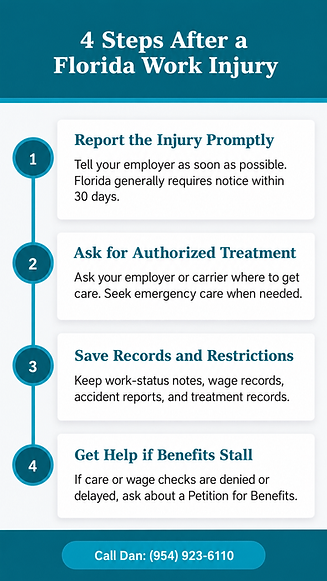
Report the injury promptly. Tell your employer about the workplace injury as soon as possible. Florida law generally requires notice within 30 days, although exceptions may apply.
-
Get authorized medical treatment. Ask your employer or workers’ compensation insurance carrier where to obtain treatment, and accurately explain how the injury occurred and what symptoms you are experiencing. Seek emergency care when necessary.
-
Follow your doctor's treatment and work restrictions. Attend authorized appointments and keep copies of work-status notes, medical paperwork, wage records, and accident reports.
-
Get legal advice if problems develop. Consider contacting a Florida workers’ compensation attorney if treatment is denied or delayed, wage benefits are unpaid or stopped, your employer cannot accommodate your restrictions, or the claim is disputed.
Workers' Compensation Benefits
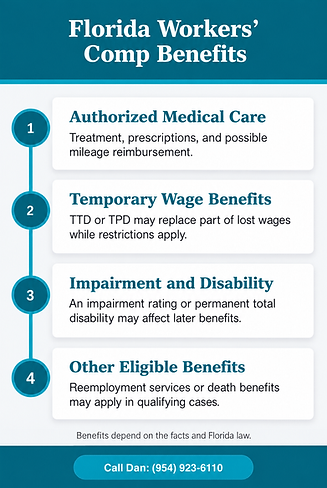
Florida workers’ compensation benefits may include authorized medical treatment, partial wage-replacement benefits, impairment income benefits, permanent total disability benefits, reemployment services, mileage reimbursement, and death benefits for qualifying dependents. Our guide to Florida workers’ compensation settlement factors explains how disability, future medical care, work restrictions, vocational needs, disputed benefits, and other considerations can affect a claim. The Florida Division of Workers’ Compensation provides official information, forms, coverage resources, and guidance for injured workers. The benefits available in any particular claim depend on the employee’s medical condition, average weekly wage, work restrictions, authorized treatment, employment status, timely reporting, and other statutory requirements. Temporary total disability (TTD), temporary partial disability (TPD), permanent impairment, permanent total disability, reemployment, and death benefits may apply depending on the claim.
Who Chooses Your Workers’ Compensation Doctor?
In most Florida workers’ compensation cases, the employer or insurance carrier authorizes the treating physician and must approve medically necessary care related to the workplace injury. Authorized treatment may include diagnostic testing, specialist referrals, surgery, physical therapy, prescription medication, medical equipment, and mileage reimbursement. Treatment obtained independently may not be covered unless an exception applies, although an injured worker may have the right to request a one-time change of authorized physician. The authorized doctor’s opinions about medical causation, work restrictions, maximum medical improvement, and permanent impairment can affect both medical and wage benefits. If treatment, testing, referrals, or surgery is delayed or denied, the dispute may require legal action.
Lost-Wage Benefits After a Florida Workplace Injury
An injured employee may qualify for lost-wage benefits when an authorized physician takes the employee completely out of work or releases the employee to restricted duty that results in reduced earnings. Temporary total disability benefits may replace part of the employee’s wages while the employee is medically unable to work, while temporary partial disability benefits may apply when the employee can work within restrictions but earns less because of the injury. The amount payable depends on the employee’s average weekly wage, compensation rate, medical work status, post-injury earnings, and applicable statutory limits. Disputes frequently arise when an employer offers light-duty work that does not comply with the physician’s restrictions, the carrier calculates the average weekly wage incorrectly, or benefit checks are delayed, reduced, suspended, or terminated.
Who Is Covered by Workers' Compensation
Florida workers’ compensation generally covers employees who suffer an injury or occupational illness arising out of and occurring in the course and scope of their employment. Coverage may extend to full-time, part-time, temporary, and seasonal employees. Florida coverage requirements differ between construction and non-construction businesses. Many non-construction employers must maintain workers’ compensation insurance when they have four or more employees, while construction employers generally face broader coverage requirements. Coverage can become disputed when a business classifies a worker as an independent contractor, pays the worker in cash, treats the worker as self-employed, or fails to obtain required insurance. The label used by the employer does not necessarily control; the working relationship and Florida law must be examined.
Why Workers’ Compensation Claims Are Denied or Delayed
A workers’ compensation carrier may deny or delay benefits by disputing whether an accident occurred at work, whether the employee gave timely notice, whether the medical condition was caused or aggravated by employment, or whether the worker qualifies as an employee rather than an independent contractor.
Disputes can also involve delayed medical treatment, denied specialist referrals, preexisting conditions, work or disability status, reduced or stopped wage benefits, an independent medical examination (IME), incomplete wage information, or an alleged refusal of suitable employment.
A denial is not necessarily the end of the claim. Depending on the facts and available evidence, an injured worker may challenge denied treatment, unpaid wage benefits, or other disputed issues by filing a Petition for Benefits and proceeding through mediation and, when necessary, a final hearing before a Judge of Compensation Claims.
Our article about denied Florida workers’ compensation claims discusses common reasons carriers dispute claims and the evidence that may become important. The Florida Office of the Judges of Compensation Claims administers Florida’s mediation and adjudication system for disputed workers’ compensation claims and provides official information about district offices, judges, rules, forms, case searches, and recent decisions.
Table of Contents:
-
How Florida Workers’ Compensation Claims Work
-
What to Do After a Workplace Injury
-
Workers’ Compensation Benefits
-
Who Chooses Your Workers’ Compensation Doctor?
-
Lost-Wage Benefits
-
Maximum Medical Improvement (MMI) and Permanent Impairment (PI)
-
Who Is Covered?
-
Why Claims Are Denied or Delayed
-
Settlements
-
Third-Party Claims





Maximum Medical Improvement and Permanent Impairment
Maximum medical improvement, commonly called MMI, is the point at which an authorized physician determines that the employee’s condition is not expected to improve significantly with additional treatment. MMI does not necessarily mean that the employee has fully recovered or no longer needs medical care. After MMI, temporary disability benefits generally end, and the physician evaluates whether the workplace injury caused a permanent impairment. If a permanent impairment rating is assigned, the employee may qualify for impairment income benefits based on the rating and other statutory factors. Permanent work restrictions, the ability to return to employment, the need for continuing medical treatment, and the possibility of permanent total disability may also become important.
Workers' Compensation Settlements
A Florida workers’ compensation settlement may resolve claims for medical care, lost-wage benefits, permanent impairment, disability benefits, and other disputed or future benefits. A settlement is voluntary, and there is no standard formula for determining what a case is worth. Value may depend on the accepted injuries, medical evidence, average weekly wage, work restrictions, permanent impairment, ability to return to work, anticipated future treatment, disputed issues, and the benefits being closed. Before accepting a settlement, an injured worker should understand whether future medical rights will remain open, what benefits will end, and how the settlement may affect Medicare or other benefit programs. A settlement may also involve a separately negotiated resignation or resolution of employment-related issues.
Third-Party Claims After a Workplace Accident
Workers’ compensation generally does not provide ordinary pain-and-suffering damages, but an injured employee may have a separate personal injury claim when someone other than the employer or a protected co-employee contributed to the accident. Potential third parties may include negligent drivers, property owners, general contractors, subcontractors, vendors, equipment manufacturers, and other businesses operating at the jobsite. A third-party claim may provide compensation unavailable through workers’ compensation, including damages for pain and suffering and other losses, although the workers’ compensation carrier may assert lien or reimbursement rights against a third-party recovery. Both claims should be investigated together so that accident evidence is preserved, all responsible parties are identified, and the interaction between workers’ compensation benefits and the personal injury recovery is properly evaluated.
Florida Workplace Injuries - What the Statistics Show
Workplace injuries can leave employees facing medical treatment, missed work, and reduced income. Florida workers’ compensation may provide authorized medical care and partial wage-replacement benefits, but obtaining those benefits is not always straightforward. In 2024, private-industry employers reported an estimated 2.49 million nonfatal workplace injuries and illnesses nationwide, according to the U.S. Bureau of Labor Statistics. BLS separately recorded 5,070 fatal work injuries, including 284 deaths in Florida. Transportation incidents caused 109 of Florida’s workplace deaths, while falls, slips, and trips caused 66.
Florida’s workers’ compensation data shows the impact close to home. For injury year 2024, the Florida Division of Workers’ Compensation Claims Statistics Database listed 57,699 lost-time claim records statewide. Miami-Dade, Broward, Palm Beach, and Monroe Counties accounted for 14,938 records—about 26% of the statewide total—and more than $574 million in reported total benefits as of September 1, 2026.
Statewide, the leading causes among Florida lost-time claims were strains or sprains (30%), falls or slips (29%), and being struck or injured (14%), according to the Florida Division of Workers’ Compensation’s 2025 annual report. The leading industries by claim volume were retail trade, construction, health care and social assistance, and transportation and warehousing. For a fuller explanation of the data and its limitations, read What the Statistics Show About Workplace Injuries and Workers’ Compensation in Florida.
These sources measure different things and should not be combined into a single injury total. They also cannot predict the value or outcome of an individual claim. Under Florida law, eligibility generally turns on whether an injury arose out of work performed in the course and scope of employment—not on proving an OSHA violation. Daniel B Reinfeld, PA helps injured workers document workplace accidents, seek authorized medical care and wage benefits, and challenge delayed, denied, or underpaid benefits.
Serving Hollywood's Neighborhoods and Workplaces
Whether you work at Memorial Regional Hospital, Seminole Hard Rock, a drive-through restaurant, a hotel, a car dealership, or on a construction site, Dan represents injured workers throughout Hollywood, Florida — including Hollywood Beach, Downtown Hollywood and Young Circle, Hollywood Hills, Emerald Hills, Liberia, Washington Park, unincorporated West Hollywood, Hollywood Lakes, and Park East, across ZIP codes 33019, 33020, 33021, 33023, and 33024 — as well as throughout Broward, Miami-Dade, Palm Beach, and Monroe Counties. Every industry carries its own injury patterns, and Dan has represented Hollywood-area employees across the workplaces that drive the local economy:
Healthcare Workers — Memorial Regional Hospital, Joe DiMaggio Children’s Hospital, and Memorial Healthcare System employees may face patient-lifting injuries, back injuries, needlestick exposures, slips and falls, and workplace violence. Dan represents nurses, technicians, and support staff in Hollywood workers’ compensation claims.
Hospitality & Tourism Workers — Seminole Hard Rock, Margaritaville Hollywood Beach, Diplomat Beach Resort. Hollywood's hotels, resorts, and casino floor employ thousands of housekeepers, servers, security officers, and maintenance workers. Common injuries include lifting injuries, burns, slip-and-falls, and repetitive trauma.
Public Safety Employees — City of Hollywood, Hollywood Police Department, Hollywood Fire Rescue. Florida law includes special presumption rules for certain conditions affecting law enforcement officers and firefighters — including some cancers, heart and vascular conditions, and infectious diseases — that can shift the burden of proof in the employee's favor. If you work for the City of Hollywood, Hollywood Police Department, or Hollywood Fire Rescue and were hurt or diagnosed with a covered condition, ask Dan whether a presumption applies to your claim.
Automotive & Dealership Employees — Toyota of Hollywood and other Local Dealership technicians, mechanics, and service advisors face lifting injuries, chemical exposure, and equipment accidents. Dan represents automotive employees, including all other South Florida dealerships.
Why Choose Daniel B Reinfeld, PA?
Daniel B Reinfeld, PA is a boutique litigation firm representing injured workers in Hollywood and throughout South Florida. You work directly with Dan, an experienced Florida attorney with more than 25 years of legal experience and former insurance-defense knowledge. The firm handles disputed workers’ compensation claims involving medical treatment, work restrictions, lost-wage benefits, permanent impairment, and other benefits available under Florida law.
Workplace Injuries and Workers We Represent
Daniel B Reinfeld, PA represents workers injured in construction accidents, warehouse accidents, workplace falls, work-related motor vehicle crashes, delivery accidents, forklift and machinery accidents, lifting injuries, repetitive trauma claims, and occupational diseases. Workplace injuries can include back and neck injuries, herniated discs, knee and shoulder injuries, rotator cuff tears, hand and foot injuries, carpal tunnel syndrome, eye injuries, traumatic brain injuries, and amputations.
The firm has represented workers from a wide range of occupations, including construction and warehouse workers, police officers, firefighters, healthcare workers and nurses, teachers, restaurant and hotel employees, truck and delivery drivers, Amazon workers, office workers, and municipal employees.
Milestones in a Florida Workers’ Compensation Claim
Your Florida workers’ compensation claim may change as medical treatment progresses and your ability to work changes. These are some of the important milestones that can affect medical care, lost-wage benefits, and the course of a claim.
Reporting the Workplace Injury
Report a workplace injury as soon as possible. Florida generally requires notice to the employer within 30 days, although exceptions may apply. Prompt reporting also helps document when, where, and how the injury occurred.
Authorized Medical Treatment Begins
The employer or workers’ compensation carrier generally authorizes the treating physician and medically necessary care for the workplace injury. Treatment may include diagnostic testing, therapy, specialist referrals, medication, injections, or surgery depending on the injury.
The Doctor Sets Work Restrictions
The authorized physician’s written work status can affect entitlement to lost-wage benefits. The doctor may take an employee completely out of work or permit work with restrictions on lifting, standing, driving, hours, or other activities.
The Employer Offers—or Cannot Offer—Light Duty
What happens after a light-duty release can affect temporary partial disability benefits. The employer may offer light-duty work within the authorized restrictions. The duties, hours, wages, and whether those restrictions are actually accommodated can all become important
The Average Weekly Wage Is Established
The average weekly wage is used to calculate workers’ compensation wage benefits. Incomplete or incorrect wage information can result in an incorrect compensation rate and underpayment of benefits.
The Worker Reaches Maximum Medical Improvement
Maximum medical improvement, or MMI, marks an important transition from temporary disability toward consideration of permanent impairment. MMI does not necessarily mean the worker is completely healed or will not require additional medical care.
A Permanent Impairment Rating Is Assigned
After MMI, a permanent impairment rating may determine entitlement to impairment income benefits. The impairment rating is different from work restrictions and does not necessarily determine whether the employee can return to the former job.
Another Person or Company May Be Responsible
A workplace accident can sometimes create a third-party personal injury claim in addition to workers’ compensation benefits. This can occur when an employee is injured by a negligent driver, defective product, property owner, contractor, or another responsible third party.
Evidence May Need to Be Preserved
Important evidence can disappear after a workplace accident. Depending on the case, photographs, video, incident reports, witness information, damaged equipment, payroll records, work schedules, medical records, and written work restrictions may become important if benefits are later disputed.
Frequently Asked Questions About Florida Workers’ Compensation
What should I do after getting hurt at work in Florida?
Report the injury promptly and ask for authorized medical treatment. Tell your employer when, where, and how you were hurt. Keep copies of accident reports, photographs, witness information, medical records, work-status notes, wage records, and communications with your employer or insurance carrier. If you need emergency care, tell the provider that the injury happened at work.
How long do I have to report a work injury in Florida?
Report it as soon as possible. Florida Statutes § 440.185 generally requires notice to the employer within 30 days after the date or initial manifestation of the injury, subject to statutory exceptions. Delay can make the claim harder to document. See the Florida Division of Workers’ Compensation’s reporting guidance.
What if my employer did not report my work injury?
You may report the injury directly to the workers’ compensation insurance carrier. Put your notice to the employer in writing and keep a copy. Ask for the First Report of Injury and the carrier’s contact information, which should be posted at work. If you cannot obtain it, the Florida Employee Assistance and Ombudsman Office can help at (800) 342-1741. The state’s reporting guidance explains this option.
How do I file a workers’ comp claim in Florida?
First, report your work injury to your employer promptly and ask where to obtain authorized treatment. Your employer generally reports the injury to its workers’ compensation insurer using a First Report of Injury; keep your own record of when and how you gave notice. If the employer will not report it, contact the insurer directly or ask the Florida Employee Assistance and Ombudsman Office for help. Reporting an injury is different from filing a Petition for Benefits, which requests a ruling on a disputed or unpaid benefit.
Can I get workers’ comp if the accident was my fault?
Often, yes. Florida workers’ compensation generally does not require you to prove that your employer was negligent, and an ordinary mistake by the worker does not automatically defeat a claim. You must still establish a compensable injury arising out of work in the course and scope of employment. Statutory exclusions can apply, including an injury occasioned primarily by intoxication or an intentional effort to injure someone. See Florida Statutes § 440.09.
Who qualifies for workers’ compensation benefits in Florida?
Employees with a compensable work-related injury or illness may qualify. Coverage depends on the employer, the actual working relationship, and the facts of the injury. Full-time, part-time, temporary, and seasonal employees may be covered. Being paid in cash or called an “independent contractor” does not by itself settle whether Florida workers’ compensation applies.
Can a repetitive injury or preexisting condition qualify for Florida workers’ compensation?
Possibly. A claim may involve repetitive lifting, carpal tunnel symptoms, occupational disease, or chemical exposure rather than one sudden accident. A prior back, neck, shoulder, or knee condition does not automatically defeat a later work-injury claim. The work duties, medical evidence, timing, and applicable causation rules matter. Learn how repetitive work-injury claims are evaluated.
What kinds of Hollywood workplace injuries and jobs does your firm handle?
We evaluate work injuries across Hollywood’s healthcare, hospitality, construction, warehouse, delivery, restaurant, retail, and public-safety workplaces. Claims can involve falls, lifting injuries, machinery, work-related vehicle crashes, repetitive trauma, and occupational illness. Common injuries include herniated discs, fractures, rotator-cuff tears, knee injuries, carpal tunnel syndrome, and head injuries. Coverage and available claims depend on the worker and the accident; a construction-site injury may also raise a third-party claim.
What if my Hollywood employer has no workers’ compensation insurance?
Coverage should be verified before assuming there is no claim. Florida’s insurance requirements vary by industry and employer size, and a business may have coverage even if a supervisor says otherwise. If the employer cannot provide carrier information, you can use the state’s coverage search or contact the Employee Assistance and Ombudsman Office at (800) 342-1741.
Who chooses my workers’ compensation doctor in Florida?
The employer or workers’ compensation insurance carrier generally chooses the initial authorized treating doctor. That doctor’s opinions can affect treatment, work restrictions, maximum medical improvement (MMI), and permanent impairment. Treatment you arrange independently may not be covered unless an exception applies. Florida law also provides a procedure for requesting a change of physician. Learn about authorized medical benefits.
Can I request a one-time change of workers’ compensation doctor in Florida?
Yes. Florida law allows a written request for one change of physician during treatment for an accident. Keep a copy and proof of receipt. The carrier generally has five days after receiving the request to authorize an alternative physician; its response can affect who chooses the new doctor. See Florida Statutes § 440.13(2)(f).
What medical treatment does Florida workers’ compensation cover?
Workers’ compensation generally pays for authorized, medically necessary treatment related to a compensable workplace injury. Depending on the condition, care can include physician visits, diagnostic testing, physical therapy, medication, injections, specialist care, surgery, and other authorized treatment. Mileage to authorized treatment or a pharmacy may also be reimbursable. See our Florida workers’ compensation medical-benefits guide.
Why did I receive a bill for authorized workers’ compensation medical treatment?
A bill does not necessarily mean you owe it. Authorized medical bills should be sent by the provider to the workers’ compensation carrier. Give the carrier or your attorney a copy, confirm that the provider has the correct claim information, and ask whether authorization or payment is disputed. Do not ignore a collection notice. The Florida Division of Workers’ Compensation advises injured workers who receive a treatment bill to contact the carrier or its office.
What if the workers’ compensation insurer denies surgery or specialist treatment?
Ask for the specific reason and keep the request and response. A dispute may concern authorization, medical necessity, causation, or whether the requested care relates to an accepted body part. A delayed authorization can also require action even without a formal denial. Depending on the facts, a Petition for Benefits may be appropriate. Read our guide to denied or delayed claims.
What happens if my workers’ compensation doctor says I cannot work?
You may qualify for temporary total disability (TTD) benefits if your authorized doctor takes you completely out of work because of the workplace injury. TTD replaces a portion of lost wages while you are medically unable to work, subject to Florida’s eligibility rules, waiting period, and statutory limits. Keep every written work-status note. Learn how Florida lost-wage benefits work.
When should my first Florida workers’ compensation check arrive?
Florida’s payment deadlines depend on when disability begins and whether it is continuous. When disability is immediate and continuous for at least eight calendar days, § 440.20 generally requires the carrier to pay the first installment of total-disability compensation or deny compensability no later than the 14th calendar day after the employer receives notice. A different deadline applies when the first seven days of disability are nonconsecutive or delayed. A report alone does not guarantee a check: the authorized doctor’s disability findings, the initial waiting period, and a coverage dispute can affect payment. If you are missing work and no check arrives, ask the adjuster what benefit was accepted or denied and why. The Division’s injured-worker FAQs provide general guidance.
How much does Florida workers’ compensation pay for lost wages?
The amount depends on your average weekly wage, disability status, and the benefit involved. Florida generally calculates TTD at 66⅔% of the employee’s average weekly wage, subject to statutory rules and maximums. Temporary partial disability (TPD) may apply when restrictions reduce your earnings. An incorrect average weekly wage can result in underpaid benefits. Read our lost-wage benefits guide.
How is average weekly wage (AWW) calculated in a Florida workers’ compensation claim?
Average weekly wage (AWW) is calculated using Florida’s statutory rules and accurate earnings information. Wages in the period before the accident commonly matter, but the correct calculation can change with the employee’s work history and other statutory factors. Review the wages, dates, and any comparable-employee information the carrier used if your compensation rate looks wrong. See our average weekly wage (AWW) guide.
What happens if my doctor releases me to light duty?
Your employer may offer work that complies with the restrictions imposed by your authorized doctor. If you cannot earn at least 80% of your pre-injury average weekly wage because of those restrictions, you may qualify for temporary partial disability (TPD) benefits. Keep copies of the restrictions and document the duties, hours, and wages actually offered. Read about TPD and other lost-wage benefits.
What if workers’ compensation denies treatment or stops my checks?
A denial or termination does not necessarily end your workers’ compensation claim. Disputes can involve medical treatment, TTD or TPD benefits, average weekly wage, work restrictions, MMI, impairment benefits, or whether the injury is compensable. Ask for the carrier’s reason, keep all notices, and compare them with your medical and wage records. A Petition for Benefits may be appropriate when benefits are denied or unpaid. See our denied-claims guide.
What is an independent medical examination (IME) in a Florida workers’ compensation case?
An IME is a medical evaluation used to address a dispute about the injury, treatment, work status, or impairment. Either side may seek an IME under Florida’s procedures. Keep the notice, bring an accurate history, and discuss any conflict between the IME and your authorized doctor’s opinions with your attorney. An IME is different from your regular authorized treatment. See Florida Statutes § 440.13.
What does maximum medical improvement (MMI) mean?
MMI means your condition is not reasonably expected to improve significantly with additional treatment. It does not necessarily mean you are completely healed or no longer need medical care. At MMI, temporary disability benefits generally change or end, and permanent impairment and work restrictions may be evaluated. Learn about MMI and disability benefits.
What happens if I receive a permanent impairment rating?
A qualifying permanent impairment rating may entitle you to impairment income benefits after MMI. The rating measures permanent loss under Florida’s workers’ compensation system and helps determine the amount and duration of impairment benefits. It is different from your work restrictions or ability to return to your former job. See our impairment and disability guide.
What if I cannot return to my former job after a Florida work injury?
Your restrictions, possible disability benefits, and eligibility for reemployment services should be reviewed. Depending on the circumstances, Florida may provide vocational counseling, job-search assistance, training, or other services to help an eligible worker return to suitable employment. Florida’s injured-worker FAQs explain these services.
What if my Florida workers’ compensation claim is denied?
A denied Florida workers’ compensation claim can be challenged. First identify whether the carrier disputes the accident, employment status, medical causation, one body part, a treatment request, or a particular wage benefit. The evidence and requested remedy depend on the precise denial. Our denied-claims guide explains common disputes and the Petition for Benefits process.
What is a Petition for Benefits in a Florida workers’ compensation case?
A Petition for Benefits asks the Office of the Judges of Compensation Claims to resolve specific benefits that are due and unpaid. It should identify the treatment, payment period, mileage, or other benefit sought with the detail Florida law requires. Disputed petitions may proceed through mediation and, if unresolved, a hearing. See Florida Statutes § 440.192 and our denied-claims guide.
What happens at Florida workers’ compensation mediation, a deposition, or a hearing?
At mediation, you and the insurer try to resolve disputed benefits with a mediator; the mediator does not decide the case for you. In a workers’ comp deposition in Florida, a lawyer may ask questions under oath about the accident, medical history, treatment, and work. If the dispute remains unresolved, a Judge of Compensation Claims may hear evidence and rule on the benefits requested in the Petition for Benefits. Your attorney can explain which events are scheduled, help you prepare, and review the issues being decided. See Florida Statutes §§ 440.25 and 440.30.
How long do I have to file a Florida workers’ compensation claim?
Different deadlines apply, so do not wait to protect the claim. Florida generally requires notice to the employer within 30 days, subject to exceptions. A separate statute of limitations governs petitions for benefits; prior medical treatment or benefit payments can affect the analysis. Have the dates reviewed instead of assuming that reporting the accident kept every future benefit request open. See Florida Statutes § 440.19.
Can I be fired for filing a workers’ compensation claim in Florida?
An employer may not fire, threaten, intimidate, or coerce you because you made or attempted to make a valid workers’ compensation claim. Florida law does not, however, require an employer to keep every position open indefinitely. If your job changes after you report an injury, preserve messages, performance records, work restrictions, and the dates of each decision. Restrictions, leave, accommodations, or retaliation may also raise employment-law issues alongside a workers’ compensation claim. See Florida Statutes § 440.205.
Can I sue my employer after a workplace injury in Florida?
Workers’ compensation generally limits a covered employee’s injury claim against the employer, subject to narrow statutory exceptions. A separate personal injury case may still exist against a legally responsible third party, such as a driver, equipment manufacturer, or another company at a jobsite. Contractor relationships and immunity can be complicated, so identify the parties before ruling out a claim. Read about Florida workplace third-party claims.
Can I have a workers’ compensation claim and a personal injury case?
Yes. You may have both claims when someone other than your employer or a protected co-worker caused your workplace injury. Examples include negligent drivers, defective products, dangerous property conditions, or unrelated contractors. A third-party personal injury claim may provide damages unavailable through workers’ compensation, although the carrier may have reimbursement rights. Read our third-party workplace-accident guide.
How much is my Florida workers’ compensation settlement worth?
There is no standard settlement amount. The value may depend on accepted injuries, average weekly wage, work restrictions, impairment, disputed benefits, future treatment, and which rights the agreement will close. Settlement is voluntary. Read our Florida workers’ compensation settlement guide.
Who pays for medical treatment after a workers’ compensation settlement?
If a settlement closes your future medical benefits, you generally become responsible for future care related to the settled claim. Compare the proposed agreement with expected prescriptions, therapy, specialist care, possible surgery, and any Medicare issues before deciding. A settlement does not automatically leave medical benefits open. Learn what to consider before settling.
What benefits may be available after a fatal workplace accident in Florida?
Qualifying dependents may be entitled to Florida workers’ compensation death benefits. The accident may also need to be investigated for a separate third-party wrongful-death claim if another person or company caused the death. Benefit eligibility, recipients, and deadlines depend on the facts. The Florida Division of Workers’ Compensation describes the available death-benefit categories.
How long does a Florida workers’ compensation case take?
There is no single timeline. Treatment, work restrictions, disputes, MMI, petitions, mediation, and settlement decisions can each affect how long a case remains active. A faster settlement can close future benefits, so timing should be evaluated alongside what rights you would give up.
Are Florida workers’ compensation benefits taxable?
Generally, workers’ compensation benefits paid under a workers’ compensation law are exempt from federal income tax. An exception may arise when workers’ compensation reduces Social Security or equivalent railroad retirement benefits; the offset portion can be taxable under the rules for those benefits. Wages paid for light-duty work are wages, not workers’ compensation benefits. If an offset or another source of income is involved, ask a tax professional to review the figures. See IRS Publication 525.
How much does a Hollywood workers’ compensation lawyer cost?
A consultation with Dan is free; ask for the workers’ compensation fee terms before hiring counsel. Florida workers’ compensation attorney fees are subject to special rules and approval requirements; in some disputes the carrier may be responsible for a fee. Ask how fees and costs would work in your workers’ compensation claim and in any separate third-party injury case. See Florida Statutes § 440.34.
When should I call a Hollywood workers’ compensation lawyer?
Call a Hollywood workers’ compensation lawyer when benefits are denied, delayed, underpaid, or stopped—or when you are unsure what benefits you should receive. Legal advice may also help when your employer does not report the injury, your doctor changes your work status, your employer cannot accommodate restrictions, your average weekly wage appears incorrect, you reach MMI, receive an impairment rating, need additional treatment, face possible retaliation, or another person or company contributed to the accident.
Speak Directly With Hollywood Workers’ Compensation Attorney Dan Reinfeld
Injured at work? Call Dan directly at (954) 923-6110 for a free consultation. No attorney’s fee unless compensation is recovered. You decide where your case goes. 📞 CALL Dan: (954) 923-6110
RECENT HOLLYWOOD VERDICTS AND SETTLEMENTS
Every case is different, and no outcome can be guaranteed. These results are selected examples of our work during the past two years. They reflect the careful investigation, evidence development, and case preparation we bring to personal injury and property-damage claims. Results depend on the particular facts, law, insurance coverage, and legal circumstances of each case. Past results do not guarantee a similar outcome.
$2,000,000
Car Accident
Confidential Settlement
$1,600,000
Pedestrian Accident
VERDICT
Proven Herniated Disc and Femoral Contusion
$175,000
Condominium Leak
Water Damage to Client's Condo from faulty roof

Directions to Our Hollywood, FL Law Firm
From I-95: Take the Hollywood Boulevard exit and head east toward downtown Hollywood. Continue through Hollywood City Hall Circle. Our office will be on your right, immediately after the circle.
From Young Circle and Downtown Hollywood: Head west on Hollywood Boulevard for approximately seven blocks. Our office will be on your left, near South 25th Avenue and immediately before Hollywood City Hall Circle.
From Hollywood Beach: Take Hollywood Boulevard west from A1A, continue through downtown and Young Circle, and proceed approximately seven blocks. Our office will be on your left, shortly before Hollywood City Hall Circle.

Sitelinks: Attorney Profile | Practice Areas | Results | Locations | Blog | Scholarship
Home → Practice Areas → Workers’ Compensation