

DANIEL B REINFELD, PA
Hollywood Car Accident Attorneys
Serving Clients Throughout South Florida Since 1999
Hollywood, FL Car Accident Lawyer
Over 25 Years of Experience • Former Insurance Defense Attorney
Jury Trial-Tested • Millions Recovered for Clients
Daniel B Reinfeld, PA is a Hollywood, Florida car accident lawyer representing injured drivers, passengers, pedestrians, bicyclists, and families throughout Hollywood, Broward County, and South Florida. Since 1999, Dan has handled rear-end collisions, intersection crashes, distracted-driving and drunk-driving accidents, I-95 collisions, hit-and-run accidents, uninsured and underinsured motorist claims, Uber and Lyft crashes, commercial-vehicle accidents, catastrophic injuries, and wrongful death. A Hollywood car accident attorney can investigate fault, preserve video and vehicle evidence, identify available insurance coverage, document medical expenses and lost income, and pursue compensation for pain, permanent injury, and other legally recoverable losses.


Hollywood, FL Car Accident Lawyer with Proven Trial Experience
25+ Years in Practice | Million-Dollar Jury Trial Experience | Former Insurance-Defense Attorney
When a serious car crash causes an injury, the lawyer you hire should be prepared to do more than process an insurance claim. Dan Reinfeld is a Hollywood car accident lawyer with more than 25 years of federal and Florida state-court litigation experience, including former insurance-defense experience and a documented record of taking contested motor-vehicle accident cases through trial. His results against insurance companies are grounded in thorough investigation, careful case preparation, and proven courtroom experience. Dan secured a $1.6 million jury verdict in a pedestrian accident trial, recognized by TopVerdict among Florida’s Top 100 Personal Injury Verdicts and Top 10 Pedestrian Accident Verdicts of 2024. As a Hollywood car accident attorney, Dan personally handles each client’s case from the initial consultation through settlement, litigation, or trial.
Rideshare Accidents
Uber, Lyft, Rideshare & Delivery App drivers, insurance disputes
Why Hire Daniel B Reinfeld, PA after a Car Accident?
Why Dan? Former Insurance-Defense Experience
Dan's former insurance-defense experience helps him anticipate how insurers investigate, evaluate, negotiate, and defend disputed car accident claims.
Why Dan? One attorney from beginning to end
Dan personally handles each case from consultation through settlement or trial, provides direct attorney access and prompt communication, and does not hand the file to an associate or outside trial counsel if negotiations reach an impasse.
Car accident claims are insurance cases as much as they are negligence cases. The claims require proving negligence while anticipating how the insurance company will challenge fault, medical treatment, prior injuries, causation, coverage, and damages.
What Should You Do After a Car Accident in Florida?
What you do after a Florida car accident can affect your health, insurance benefits, and claim. Once everyone is safe, take these steps to preserve evidence and protect your rights.
1. Check for Injuries and Move to Safety
Check everyone for injuries and call 911 if anyone needs medical assistance. If safe, photograph the vehicles’ resting points before moving them out of traffic. Remain at the scene, exchange information, and assist anyone injured as required by Fla. Stat. §§ 316.027 and 316.062.
2. Call 911. Request Police and EMS
Call police and EMS if anyone is injured or reports pain, a vehicle requires towing, impairment is suspected, or a driver attempts to leave. Florida requires a long-form report for crashes involving injury or pain, DUI, hit-and-run, tow-away vehicles, or commercial motor vehicles. If police do not investigate a reportable crash, submit a written report to FLHSMV within 10 days. See Fla. Stat. §§ 316.065 and 316.066.
3. Exchange Information. Don't Debate Fault at the Scene
Exchange names, driver’s-license information, insurance information, and license-plate numbers. Do not apologize or speculate about fault, speed, distance, or injuries. Statements made to the investigating officer are generally inadmissible in a civil trial, but statements to drivers, witnesses, or insurers are not protected. Florida may divide fault between drivers, and a claimant found more than 50% at fault generally cannot recover. See Fla. Stat. §§ 316.066(4) and 768.81.
4. Document the Scene
Photograph the vehicles, damage, road conditions, and injuries before the vehicles are towed. Obtain independent witnesses’ names and phone numbers before they leave. If a vehicle contains black-box data, dash-cam footage, or evidence of mechanical failure, consult a lawyer before it is repaired, sold, or salvaged. Once the vehicle is gone, the evidence may be lost.
5. Seek Medical Treatment Within 14 Days
Do not ignore headaches, numbness, soreness, or neck and back pain. Some crash injuries appear hours or days later. Prompt treatment protects your health and documents the connection to the accident. Florida PIP generally requires initial treatment within 14 days and pays 80% of covered medical expenses, subject to policy limits and any deductible. Benefits may be limited to $2,500 unless a provider determines that you suffered an emergency medical condition. Fla. Stat. § 627.736.
6. Save Records and Keep a Calendar
Use a calendar notebook to track appointments, symptoms, missed work, and communications with insurers and medical providers. Keep medical records, bills, prescriptions, health-insurance EOBs, wage-loss records, medical-mileage logs, out-of-pocket receipts, insurance correspondence, claim numbers, and policy documents.
7. Get the Crash Report and Public Records
Florida Statute § 316.066 requires that a Florida Traffic Crash Report be completed within 10 days after an investigation. Have your attorney obtain the official report through the agency or Florida Crash Portal. Ensure to request promptly any 911 recordings, dispatch records, EMS and fire-rescue records, patrol-car video, and police body-worn camera footage before applicable retention deadlines expire.
8. Secure Evidence from Outside Sources
Act quickly to preserve recordings of the crash or its aftermath, including nearby businesses, residences, condominiums, parking lots, Ring and other doorbell cameras, and vehicle dash cams. Retention periods vary, and recordings may be overwritten or deleted quickly. Obtain towing records, and repair estimates.
9. Notify Your Own Insurer — Be Careful with Recorded Statements
Have your attorney notify your insurance carrier on your behalf. Most policies require prompt notice and reasonable cooperation, which may include a recorded statement. Do not give a statement to the other driver’s insurer before obtaining legal advice.
10. Protect your Rights—Retain a Florida Car Accident Attorney Promptly
Retain counsel promptly. An attorney can protect your rights, preserve critical evidence, identify applicable deadlines, and evaluate available UM/UIM coverageand review Florida’s injury threshold. Fla. Stat. §627.737.
Types of Car Accident Cases We Handle
The firm represents clients injured in many forms of vehicle collisions throughout South Florida. Different crash types raise different proof and insurance issues.
Rear-End Collisions
Rear-end cases can involve disputed stopping distances, sudden-stop allegations, chain-reaction impacts, low-visible-damage defenses, or questions about whether multiple impacts occurred. Photographs, vehicle repair evidence, event data, witness accounts, and medical timing may all matter. Read More.
Intersection and Left-Turn Crashes
Intersection collisions frequently turn on right-of-way, signal phase, lane position, speed, visibility, and witness credibility. Nearby business cameras and traffic systems can be particularly important and may not retain footage indefinitely.
Head-On and Wrong-Way Crashes
Head-on collisions often produce severe injury because of combined closing speeds. Investigation may focus on impairment, distraction, fatigue, roadway design, medical events, vehicle defects, or how a driver entered the wrong lane or roadway.
Sideswipe and Unsafe Lane-Change Accidents
Sideswipe cases can be deceptively disputed because each driver may claim the other crossed the lane line. Damage patterns, roadway geometry, dash cameras, mirrors, blind spots, signaling, and electronic or witness evidence can help resolve the conflict.
Highway and I-95 Accidents
South Florida highway crashes can involve high speeds, multiple vehicles, sudden lane changes, commercial traffic, debris, construction, and secondary impacts. The number of involved vehicles and insurers can make fault allocation and coverage analysis more complex.
Distracted Driving Accidents
Texting is only one form of distraction. Navigation systems, social media, video, phone calls, food, passengers, in-car systems, and work-related communications can divert attention. Relevant electronic evidence must be obtained through lawful discovery and preserved when appropriate.
Drunk or Drug-Impaired Driving Accidents
An impaired-driving crash may generate evidence beyond the ordinary crash file, including DUI reports, body-camera footage, breath or blood testing, field sobriety materials, bar or restaurant evidence, and criminal-court records. The civil and criminal matters are separate, and the injury claim should be investigated independently.
Hit-and-Run and Uninsured Driver Accidents
When the responsible driver flees or has no usable bodily injury insurance, uninsured-motorist coverage may become critical. Prompt police reporting, witness identification, camera searches, license-plate information, debris, and policy review can determine whether a viable source of recovery exists.
Rideshare, Delivery, and Commercial Vehicle Accidents
Coverage can depend on employment, agency, vehicle ownership, commercial policy terms, app status, trip status, and contractual relationships. Preserving digital records and identifying every potentially responsible company should happen early.
Motor Vehicle Crashes Involving Children and Minors
Children can suffer physical and emotional injuries in crashes, and claims involving minors may require additional settlement procedures or court approval depending on the amount and circumstances. Parents should preserve medical, school, activity, and behavioral evidence that documents changes after the collision. The legal claim belongs to the child for the child’s injuries, even though a parent or guardian may act on the child’s behalf.
Serious and Catastrophic Auto Accident Claims
Catastrophic cases require a different level of investigation because the lifetime consequences can dwarf the immediate hospital bills. A claim involving traumatic brain injury, spinal cord damage, amputation, major orthopedic trauma, permanent cognitive impairment, or loss of independence may require life-care planning, vocational analysis, economic projections, future medical opinions, home-modification evidence, and testimony from family members who understand the day-to-day impact. In these cases, identifying all coverage and responsible parties is critical. Policy-limit investigations, umbrella coverage, commercial policies, employer liability, negligent entrustment, product defects, and other theories may materially affect the available recovery.
Fatal Traffic Crashes and Wrongful Death Claims
When a collision causes death, the family faces legal issues while dealing with a profound personal loss. Florida wrongful death claims are governed by statute, including rules about who brings the action and which survivors may recover particular damages. The personal representative generally brings the action on behalf of the estate and survivors. A fatal-crash investigation may require rapid preservation of vehicles, event data, commercial records, phone evidence, toxicology, surveillance, roadway evidence, and witness testimony. Because wrongful death actions are generally subject to a two-year limitations period and evidence can disappear much sooner, families should seek case-specific advice promptly.
Car Accident Statistics in Hollywood and Broward County, Florida
Traffic crashes remain common even as nationwide fatalities declined in 2024. National, state, county, and city data show the scale of the problem and highlight recurring issues that may require investigation after a serious Hollywood collision, including speed, distraction, impairment, intersection right-of-way, restraint use, and roadway design. These figures describe groups of crashes; they do not establish fault, causation, or damages in any individual case.
Nationwide. NHTSA’s Overview of Motor Vehicle Traffic Crashes in 2024 estimates that 6,180,241 police-reported traffic crashes occurred in 2024, killing 39,254 people and injuring an estimated 2,422,195. Passenger-vehicle occupants—people in passenger cars, SUVs, pickups, and vans—accounted for 22,713 deaths and an estimated 1,908,301 injuries. Among fatally injured passenger-vehicle occupants whose restraint use was known, 48% were unrestrained. Separate federal data identify 11,288 deaths in speeding-related crashes, 3,208 deaths and an estimated 315,167 injuries in crashes reported as distraction-affected, and 11,904 deaths in crashes involving at least one driver with a blood alcohol concentration of .08 or higher. The Federal Highway Administration’s intersection-safety overview reports that roughly one-quarter of U.S. traffic fatalities and about half of traffic injuries are attributed to intersections. These categories can overlap. A reported factor does not, by itself, prove fault in a particular alcohol-related car accident, distracted-driving collision, or intersection crash; the evidence must be evaluated case by case.
Florida. FLHSMV’s 2024 Florida Traffic Crash Facts Annual Report recorded 381,423 codable crashes, 3,098 fatalities, 14,026 incapacitating injuries, and 232,400 other injuries statewide. The report also lists 982 fatalities in its intersection-crash category, which includes railway-grade crossings, and 277 fatalities in its driver-distracted category. FLHSMV’s annual report includes only codable crashes drawn from law-enforcement reports that meet specified criteria, such as death, injury or reported pain, DUI, hit-and-run, tow-away damage, or commercial-vehicle involvement. It therefore should not be treated as a count of every minor collision or every driver-filed Florida traffic crash report.
Broward County. FLHSMV counted 38,338 crashes, 23,115 injuries, and 235 fatalities in Broward County during 2024. Compared with 2023, crashes declined 4.9% and injuries declined 5.8%, while fatalities increased 7.3%, from 219 to 235. A Broward MPO analysis of 2017–2021 crash records identified angle and left-turn collisions among the county’s most dangerous crash types and found that rear-end and lane-departure crashes also contributed significantly to severe crashes. Those countywide patterns provide context, but fault in a Hollywood collision still requires a site-specific investigation.
Hollywood. A query of Signal Four Analytics’ Florida Traffic Safety Dashboard for January 1 through December 31, 2024, returned 24 traffic fatalities and 100 serious injuries in crashes coded to Hollywood. The dashboard is updated as records change, and these figures include all road users—not only people inside passenger vehicles. Separately, City of Hollywood Resolution R-2026-141 authorized acceptance of up to $200,000 in federal Safe Streets and Roads for All funding and $50,000 in matching funds to develop a Vision Zero Action Plan. The plan’s stated goal is eliminating traffic fatalities and serious injuries. Citywide data do not prove negligence in an individual collision. They underscore the value of a prompt, case-specific investigation and early preservation of Hollywood police and crash reports and Hollywood 911 recordings.
How Fault Is Proven in a Car Accident Case
Insurance companies do not have to accept a claimant’s description of the crash. A strong liability presentation is built from evidence that can be tested: physical damage, roadway evidence, witness testimony, video, electronic data, records, and expert analysis when needed.
Important Evidence May Include
-
Florida Traffic Crash Report and related law-enforcement materials;
-
scene photographs, measurements, debris patterns, skid or yaw marks, and roadway conditions;
-
vehicle photographs, repair documentation, total-loss records, and event data recorder information when available;
-
dash-cam, surveillance, traffic-camera, doorbell-camera, rideshare, or delivery-app video and data;
-
cell-phone records or other evidence relevant to distraction, when legally obtainable;
-
witness statements and deposition testimony;
-
911 calls, body-camera footage, citations, DUI investigation materials, and toxicology evidence where relevant;
-
vehicle ownership, employment, maintenance, inspection, and commercial safety records; and
-
accident reconstruction or other expert analysis in disputed or severe crashes.
How Florida Auto Insurance Works After a Crash
Florida’s auto-insurance system is often described as “no-fault,” but that phrase is incomplete. PIP may pay certain benefits without requiring proof that another driver caused the collision, while a separate negligence claim may seek damages from an at-fault driver or other responsible party. Coverage questions can become complicated when there are multiple vehicles, household policies, rideshare apps, commercial vehicles, permissive drivers, rental cars, or uninsured motorists.
Personal Injury Protection (PIP)
Florida policies subject to the no-fault law generally provide Personal Injury Protection benefits. Under the current statute, PIP provides up to $10,000 in medical and disability benefits and $5,000 in death benefits, subject to statutory rules, exclusions, deductibles, coverage limits, and medical-necessity requirements. Medical benefits generally reimburse 80% of reasonable expenses for medically necessary covered services, and initial services and care must generally be received within 14 days after the accident. The available medical-benefit amount can depend on whether a qualifying provider determines that the injured person had an emergency medical condition. Because PIP law contains technical requirements and payment limitations, do not assume that “$10,000 of PIP” means every injured person automatically receives $10,000 toward every bill.
Bodily Injury Liability Coverage
Bodily injury liability coverage is the coverage most people think of when discussing the at-fault driver’s insurance. It can provide a source of recovery for damages the insured becomes legally responsible to pay, subject to the policy terms and limits. Florida’s insurance requirements are unusual, and not every private passenger vehicle owner carries bodily injury liability coverage merely because the car is registered and insured. That makes early coverage investigation important.
Uninsured and Underinsured Motorist Coverage
Uninsured/underinsured motorist coverage—often called UM/UIM—can be one of the most important coverages after a serious crash. Depending on the policy and facts, it may provide benefits when an at-fault driver has no bodily injury coverage or not enough coverage to compensate for the loss. Coverage may arise under more than one policy, and policy language, rejection forms, resident-relative status, vehicle occupancy, and stacking issues can matter.
Property Damage Coverage
Vehicle damage is a separate part of the claim. Depending on the available coverages and fault issues, payment may come from the at-fault driver’s property-damage liability coverage, your own collision coverage, or another applicable source. Florida requires at least $10,000 in property-damage financial responsibility for most registered vehicles. Serious multi-vehicle crashes can exhaust that amount quickly.
Rental Cars, Towing, Storage, and Diminished Value
A car-accident claim may involve more than the repair invoice. Towing and storage charges can accumulate quickly. Loss-of-use or rental issues may arise while the vehicle is being repaired. In appropriate cases, a properly repaired vehicle may still have a diminished market value because its collision history affects resale. These issues are fact- and coverage-dependent and should be documented rather than assumed.
How Much Is a Florida Car Accident Case Worth?
No ethical lawyer can determine the value of a car-accident case from an online calculator. Two people can experience similar crashes and have dramatically different claims because their injuries, medical histories, occupations, insurance coverages, fault evidence, future care, credibility, and permanency differ. We have had car accident injury cases with jury verdicts that awarded over one million dollars, and we have had car accident injury settlements settle for over two million dollars. However, the majority of cases do not resolve in that range.
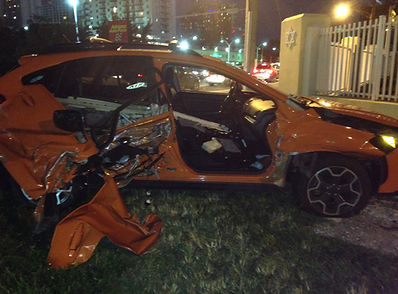
The value of a claim depends on a range of interacting factors that we present to the insurance company: the clarity of liability and any comparative fault; our tangible evidence (scene and treatment photographs, 911 calls, exhibits of car wreckage, electronic evidence) and the quality of our witnesses; the nature, severity, and permanence of the injuries; objective medical findings and diagnostic imaging; the need for injections, surgery, rehabilitation, or future treatment; past and future medical expenses; lost wages and reduced earning capacity; the effect on daily activities, family life, and independence; the quality and consistency of medical documentation; ruling out or addressing preexisting conditions and prior similar complaints; ascertaining the available bodily injury insurance, UM/UIM, commercial, umbrella, or other coverage; and venue, litigation posture, expert evidence, and trial risk.
Hollywood Crash and Injury Guide

Hollywood Crash Records and Evidence Guide
Building a strong car accident claim depends on securing evidence fast. Here are the same sources we use to help clients obtain police reports and body-worn camera footage from the Hollywood Police Department, EMS records from Hollywood Fire Rescue, 911 calls from the Broward Sheriff's Office, and traffic camera footage from FDOT, Florida's Turnpike Enterprise, and private surveillance sources across Hollywood, Florida:
How to Get a Hollywood, FL Police Report (And How Long It Takes)
How to Request Body-Worn Camera Footage From Hollywood PD
Are There Still Red Light Cameras in Hollywood, FL?
Ring Cameras, Nextdoor, and Other Surveillance in Hollywood, FL
How to Get a 911 Call Recording in Hollywood, FL — And Why You Need to Move Fast
How to Get a Hollywood Fire Rescue EMS Report (And Get Your Bill Sent to PIP)
Motor Vehicle Injury Cases Require Real Trial Preparation
Serious car accident cases require counsel who can prove fault, defeat attempts to shift blame, establish medical causation and permanent loss, uncover all available insurance coverage, and present a compelling case to a jury. With more than 25 years of litigation experience—including prior insurance-defense work—Daniel B Reinfeld, PA knows how insurers defend these claims and how to fight back.


Who Can Be Held Responsible for a Florida Car Accident?
The obvious defendant is often the driver who caused the crash, but liability can extend beyond one person. A thorough investigation asks who drove the vehicle, who owned it, whether the driver was working, whether a company controlled the trip, whether a defective component contributed, whether a roadway condition played a role, and which insurance policies may apply.
Negligent Drivers
A driver may be negligent by speeding, following too closely, failing to yield, running a red light or stop sign, making an unsafe lane change, driving while distracted, driving while impaired, failing to maintain proper lookout, or otherwise operating a vehicle without reasonable care under the circumstances.
Vehicle Owners
Florida has specific rules governing owner liability and permissive use. The legal responsibility of a vehicle owner can depend on who the owner is, the nature of the permission, whether the vehicle was leased or rented, applicable statutory caps, and whether the owner was independently negligent. Ownership should be verified rather than inferred from who was driving.
Employers and Commercial Entities
When a driver is acting within the course and scope of employment, an employer may be responsible under agency principles. Companies may also face direct-negligence theories involving hiring, training, supervision, retention, maintenance, or safety practices where the evidence supports them. Commercial policies can materially change the available insurance picture.
Rideshare and Delivery Platforms
Uber, Lyft, delivery apps, and other platform-based driving raise special coverage questions because insurance can depend on the driver’s status at the precise time of the crash—offline, logged in and waiting, en route to a passenger or delivery, or actively transporting someone. App records and electronic trip data should be preserved early.
Government Entities and Roadway Contractors
Some crashes involve dangerous roadway design, malfunctioning signals, missing signs, construction zones, debris, or maintenance problems. Claims involving a state or local government can be subject to sovereign-immunity rules, notice provisions, and different procedures. The potential government role should be identified early because ordinary claim assumptions may not apply.
What Compensation May Be Available After a Car Accident?
The value of a car-accident case depends on the evidence, available insurance or assets, legal responsibility, the nature and duration of the injuries, medical proof, employment impact, permanency, and many other factors. There is no legitimate formula that can value a case from a few facts online.
Medical Expenses
Recoverable economic damages may include reasonable past medical expenses and, when supported, future medical expenses related to the crash. The analysis may involve PIP payments, health-insurance payments, outstanding balances, contractual adjustments, liens, subrogation interests, and evidence of future care.
Lost Income and Reduced Earning Capacity
A crash can cause missed work, reduced hours, lost commissions, lost business income, or an inability to return to the same occupation. Claims for past wage loss and future loss of earning capacity require documentation. Tax returns, payroll records, employment files, disability notes, vocational evidence, and expert testimony may become important depending on the size of the loss.
Pain, Suffering, Mental Anguish, and Inconvenience
Florida law limits recovery of noneconomic damages in many motor-vehicle cases unless the injury satisfies a statutory threshold. Under §627.737, qualifying circumstances include significant and permanent loss of an important bodily function, permanent injury within a reasonable degree of medical probability, significant and permanent scarring or disfigurement, or death. Medical evidence is therefore central in cases seeking pain-and-suffering damages.
Property Damage and Other Economic Losses
Vehicle repair or total-loss value, towing, storage, rental or loss-of-use expenses, damaged personal property, and other documented economic losses may also be part of the overall claim depending on coverage and fault.
Wrongful Death Damages
A fatal crash is governed by Florida’s Wrongful Death Act and presents different beneficiaries, damages, and procedural requirements. Families should obtain case-specific advice promptly. Evidence involving the vehicles, commercial records, electronic data, toxicology, and roadway conditions can disappear long before the legal deadline expires.
Answers to Common Questions
How long does a car accident claim take?
There is no single timeline. A straightforward claim with clear fault and resolved injuries may settle relatively quickly. A case involving surgery, uncertain prognosis, disputed liability, insufficient policy limits, multiple insurers, expert testimony, or litigation can take substantially longer. The goal should be an appropriate resolution based on the developed evidence, not speed for its own sake.
What if the Other Driver Has Little or No Insurance?
A lack of obvious insurance does not necessarily mean the claim has no value. Counsel should complete an insurance investigation before assuming there is no recovery source. Potential coverage can come from several places: the driver's own policy, a vehicle-owner's policy, an employer or commercial policy, rideshare or delivery platform coverage, household policies, umbrella policies, or the injured person's own uninsured/underinsured motorist (UM/UIM) coverage. Other responsible parties may also share liability and bring additional coverage into play. Insurance is often the principal source of recovery, but the realistic collectability of any judgment matters too. In serious cases, a thorough asset and coverage investigation — rather than an assumption that no coverage exists — is warranted before drawing conclusions about a claim's value.
Will my car accident case go to trial?
Most civil cases resolve without a jury verdict, but no responsible lawyer can guarantee settlement. A case is more likely to litigate when the parties disagree materially about fault, medical causation, permanency, damages, insurance coverage, or settlement value. Preparing as if trial is possible can improve the quality of both litigation and settlement decisions.
Does Florida still have a no-fault system?
Florida’s current statutory framework still includes PIP/no-fault benefits. But “no-fault” does not mean fault is irrelevant. Fault matters for claims against negligent drivers and other responsible parties, comparative negligence, property damage, and the recovery of damages beyond PIP.
What happens if I was partly responsible?
Florida generally reduces damages according to the claimant’s share of fault. Under the current modified comparative-fault rule, a claimant found more than 50% at fault for his or her own harm generally cannot recover damages in an ordinary negligence action.
Can I post about the accident on social media?
Assume that public posts can be found and reviewed. Photographs, activity posts, location data, comments about the crash, and statements about physical condition may be taken out of context. Do not delete or alter existing evidence if litigation is anticipated; instead, get legal advice about preservation and future posting.
Should I Talk to the Other Driver’s Insurance Adjuster?
The other driver’s insurer does not represent you. Its adjuster is gathering information to evaluate the company’s financial exposure. A recorded statement can lock in wording before the injured person has seen the crash report, reviewed photographs, or understood the full medical picture.
What If I Was a Passenger?
Passengers are frequently in a strong position on fault because they usually did not cause the collision, but the insurance analysis can involve both vehicles and multiple policies. A passenger may have PIP rights, claims against one or more negligent drivers, and possible UM/UIM rights depending on the facts and policies. Family relationships and household policies can also affect coverage.
What If I Was Driving for Work?
A person injured while working may have overlapping systems: a workers’ compensation claim and a third-party negligence claim. Workers’ compensation can provide benefits without requiring proof that another driver was negligent, while a third-party case may seek damages not available in workers’ compensation. Liens and reimbursement rights may connect the two matters, so coordination is important.
How Long Do You Have to File a Florida Car Accident Lawsuit?
Never hesitate to protect your rights and the evidence. Speak with an attorney now to protect your rights and preserve evidence while it is still available. Under Fla. Stat. §95.11, Florida negligence and wrongful death claims are generally subject to a two-year statute of limitations. However, the exact deadline can vary depending on when the claim accrued, any governmental involvement, insurer insolvency, the defendant's identity, applicable tolling rules, and other case-specific facts — so confirm the deadline with an attorney rather than relying on a general rule. The limitations period should not be treated as time available to wait. Critical evidence can disappear long before the deadline arrives: surveillance footage gets overwritten, vehicles are repaired or destroyed, witnesses become difficult to locate, and memories fade. Prompt investigation is especially important in catastrophic injury cases, commercial-vehicle and rideshare crashes, hit-and-run accidents, roadway-defect claims, and cases involving disputed liability.
Local Knowledge of Hollywood Roads, Responders, and Broward Courts
Dan Reinfeld’s connection to Hollywood is personal as well as professional. His family has lived in the city since 1967, he resides in Hollywood, and the firm’s only office is at 2450 Hollywood Boulevard, near Downtown Hollywood, ArtsPark at Young Circle, and City Hall Circle. Hollywood traffic collisions occur in settings that demand different evidence. On I-95 and Florida’s Turnpike, a crash investigation may focus on high-speed merging, lane changes, commercial traffic, debris, and secondary impacts. Along US 1/Federal Highway, State Road 7/US 441, Hollywood Boulevard, Sheridan Street, Pembroke Road, Stirling Road, Hallandale Beach Boulevard, and North 21st Avenue, it may center on signal phases, left turns, following distance, lane position, right-of-way, sightlines, or nearby video. Around Downtown, Young Circle, and Hollywood Beach, evidence may also come from businesses, hotels, condominiums, parking entrances, rideshare records, or cameras capturing pedestrians and bicyclists. After a serious auto accident, local records may be held by the Hollywood Police Department’s Records Unit or Hollywood Fire Rescue EMS. Memorial Regional Hospital is a Hollywood Level I trauma center. If a claim becomes a lawsuit in Broward County, the Seventeenth Judicial Circuit administers the local courts and maintains its South Regional Courthouse at 3550 Hollywood Boulevard. The correct agency, venue, courthouse, and available records depend on the facts, which is why local familiarity should lead to specific investigative steps—not merely a list of place names.
Discuss Your Car Accident Directly With Dan
If you or a family member was injured in a Hollywood car crash, early legal work can preserve evidence, protect insurance rights, identify liable parties and coverage, and prevent important deadlines from expiring. You will speak directly with Dan—not a call center or intake department—and he personally evaluates and handles every case accepted by the firm. You do not need to travel to the Hollywood office to begin your case. Free consultations are available by telephone, Zoom, hospital visit, or home visit when appropriate. No attorney’s fee unless a recovery is obtained. Evening and weekend appointments are available. CALL Dan: 📞 (954) 923-6110
SPECIALIZED MOTOR VEHICLE & TRANSIT CLAIMS IN HOLLYWOOD
In addition to standard automobile collisions, attorney Daniel B. Reinfeld represents clients involved in complex traffic accidents across specific transit modes and insurance coverage scenarios throughout Hollywood and South Florida:
Commercial Trucking Collisions
DUI & Drunk Driving Collisions
E-Bike & Micro-Mobility Claims
Hollywood Pedestrian Accident Lawyer
RECENT HOLLYWOOD VERDICTS AND SETTLEMENTS
Every case is different, and no outcome can be guaranteed. These results are selected examples of our work during the past two years. They reflect the careful investigation, evidence development, and case preparation we bring to personal injury and property-damage claims. Results depend on the particular facts, law, insurance coverage, and legal circumstances of each case. Past results do not guarantee a similar outcome.
$2,000,000
Car Accident
Confidential Settlement
$1,600,000
Pedestrian Accident
VERDICT
Proven Herniated Disc and Femoral Contusion
$175,000
Condominium Leak
Water Damage to Client's Condo from faulty roof

Directions to Our Hollywood, FL Office
We are located immediately east of Hollywood City Hall Circle and approximately seven blocks west of Young Circle in downtown Hollywood.
From I-95: Take the Hollywood Boulevard exit and head east toward downtown Hollywood. Continue through Hollywood City Hall Circle. Our office will be on your right, immediately after the circle.
From Young Circle and Downtown Hollywood: Head west on Hollywood Boulevard for approximately seven blocks. Our office will be on your left, near South 25th Avenue and immediately before Hollywood City Hall Circle.
From Hollywood Beach: Take Hollywood Boulevard west from A1A, continue through downtown and Young Circle, and proceed approximately seven blocks. Our office will be on your left, shortly before Hollywood City Hall Circle.